Woodland Garden Trees
This garden, with its delicate perennials, could not survive without its protective canopy of trees. The largest are all native, with four species present: western red cedar (Thuja plicata), western hemlock (Tsuga heterophylla), Douglas fir (Pseudotsuga menziesii), and grand fir (Abies grandis). Below stand smaller deciduous and evergreen trees, mostly non-native, providing extra protection from the heat of the sun. These smaller trees are here on their own merits and provide attractive bark, fall foliage color, flowers, or ornamental fruits to enhance the Woodland Garden’s aesthetic appeal.
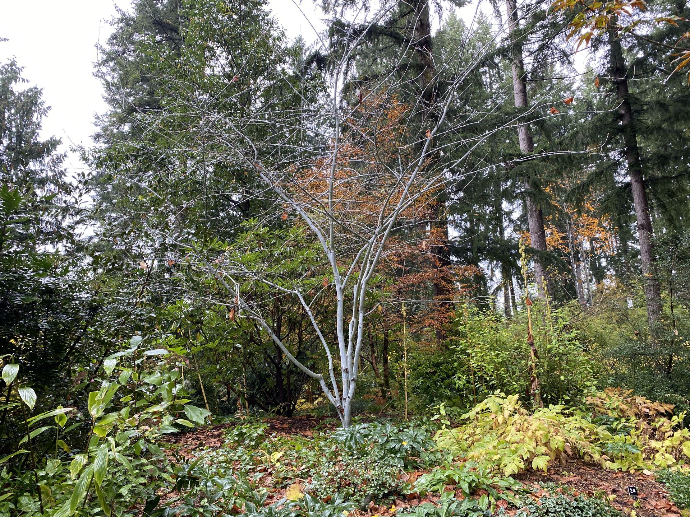
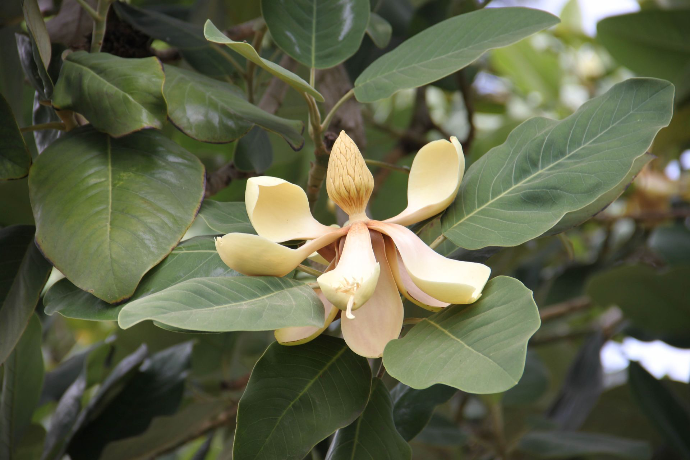
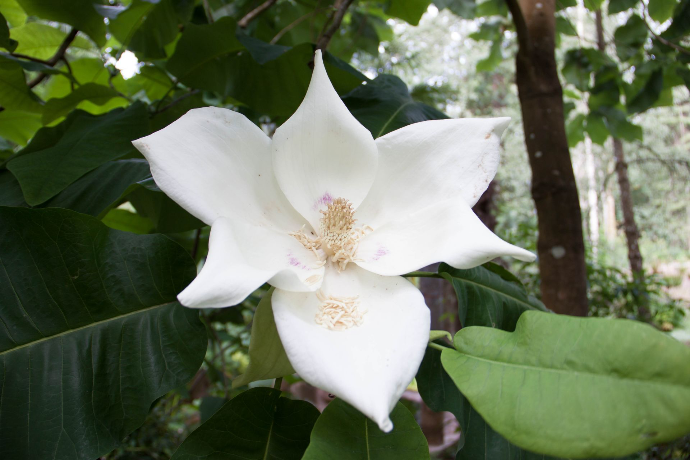
Photos left to right: Acer tegmentosum, Magnolia delavayi, Magnolia macrophylla.
Snakebark maples include several species from Asia and North America. Ours is Acer tegmentosum from China (Bed 24) and its chalky, white-striped bark has ghostly appeal throughout the winter. Our plant is of the cultivar ‘Joe Witt’, named by Dan Hinkley for the former curator of the Arboretum in Seattle, where Dan used to work. Magnolias are abundant in the Woodland Garden, and we have two specimens of the large evergreen M. delavayi (Beds 13, 23). It has pale peach flowers several inches wide, produced throughout the summer. Even larger is Magnolia macrophylla (Bed 33), a deciduous tree from eastern States with the largest undivided leaf of any American tree. The white flowers are plate sized!
As befitting a garden in the Evergreen State, we have numerous rhododendrons including the massive R. sinogrande (Bed 48). Each leathery leaf is a foot long and the bell-like flowers are cream with crimson markings. One of our largest non-native trees is Emmenopterys henryi (Bed 31) a member of the coffee family (Rubiaceae) from China and Vietnam. Though now a substantial size, it has never flowered, but we live in hope!